Leading Without a Leash
There’s a certain kind of learning that occurs when you’re uncomfortable and far from home. I first encountered it at seventeen, on a 25-day leadership course in the White Mountains of New Hampshire organized by the Appalachian Mountain Club. I didn’t fully understand what I was learning at the time. I just knew that carrying responsibility for other people through cold, sleep-deprived, physically exhausting days taught me something about how groups actually function under pressure and what it takes to hold a group together when nobody’s comfortable. You figure out quickly who you are when there’s no easy alternative.
That lesson about groups under pressure was only half my education. The other half came a few years later, at a summer camp in Pittsburgh, when I was still in college.
We were playing 4-square with a group of kids and I made a choice I’ve thought about many times since. I didn’t hold back. Played to win. And won. The kids respected that immediately. They’d been testing every adult around them all summer and they could tell in about two seconds whether you were actually present and capable or just going through the motions. The colleague I was working with couldn’t catch a kickball. They noticed and they were merciless about it. Kids at that age certainly have an ability to detect inauthenticity and incompetence.
What I took from that wasn’t “be dominant.” It was something more specific: you have to demonstrate capability before you can earn trust, and you have to earn trust before you can hand responsibility over. Once a group knows where you’re coming from, once they’ve seen you handle something hard and handle it well, they extend you a kind of credit. They stop questioning every decision. They follow, not because they have to, but because they’ve decided you’re worth following.
I carried both lessons with me when I started working at Keewaydin Environmental Education Center: group dynamics under pressure from the White Mountains, trust through competence from that blacktop in Pittsburgh.
The students hadn’t signed up for this themselves. Their school had. Some of them were excited and curious kids who lit up when you asked them to flip over a rock and identify what was living underneath it. Others were already somewhere else, arms crossed, waiting for the week to end. My job there was to teach all of them — the eager ones and the checked-out ones — about natural history, climate, and the ways humans have shaped the ecosystems around them. And I had about thirty seconds to earn their attention before I lost it entirely.
No one taught me how to do that part in design school.
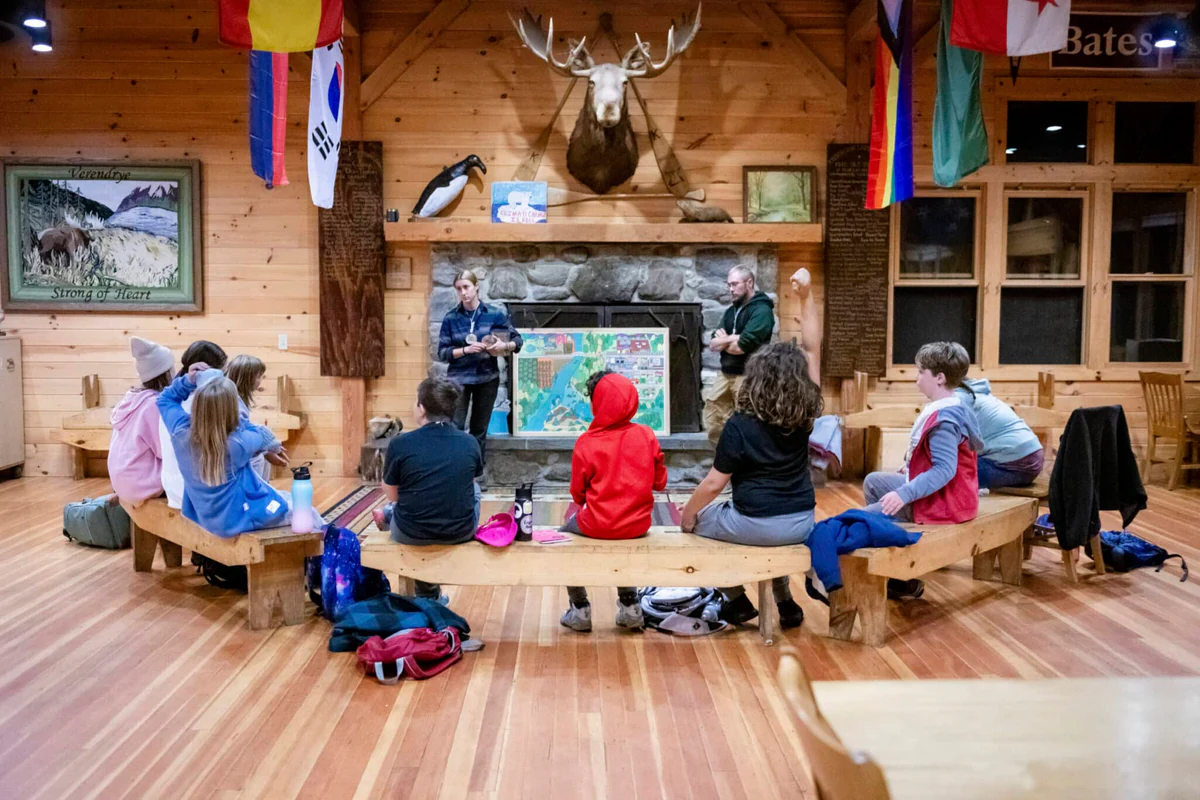
The instructional work was actually the easy part. Taking a complex idea — a food web, a carbon cycle, the slow logic of succession in a forest — and distilling it into something a twelve-year-old could genuinely grasp is a design problem. You figure out the right entry point, the right analogy, the right question to ask so they arrive at the answer themselves rather than receiving it from you. Handing someone a conclusion is far less powerful than guiding them to find it. I learned this in front of students before I ever learned it in a design studio.
The harder problem was behavior.
My instinct, early on, was to be patient to a fault. I told myself that a misbehaving student was a student with an unmet need, and that’s often true. Boredom, insecurity, a need for attention, a rough morning with a friend. Meeting the behavior with empathy and redirecting it usually worked. But not always. Some middle school students are, to put it plainly, just punks. And punks don’t respond to empathy alone. They respond to clarity, consistency, and the sense that you know what you’re doing — the same thing I’d learned on that blacktop in Pittsburgh, just with higher stakes and a lot less time to prove it.
I’ve spent the last ten years testing this theory at scale, in the least professional context imaginable: Burning Man.
For a decade, I’ve helped organize and lead a camp that has ranged from sixty to a hundred people. No one is being paid. No one has to do anything. The structures that make professional teams function — salaries, performance reviews, job descriptions, the implicit threat of consequences — don’t exist. What you have is a group of people who showed up as volunteers, and your ability to keep them oriented, motivated, and functioning as a unit depends entirely on the quality of your relationships and the clarity of your vision.

I’ll say plainly: it is harder to lead a volunteer camp than it is to lead a design team. Not because the stakes are higher, but because the leverage is different. Every tool you’d normally reach for is gone. What’s left is the real work of leadership: listening, resolving conflict, making decisions transparently, giving people ownership over the things they care about, and knowing when to step back and let the group carry itself.
A KEEC motto was, “No one of us is as smart as all of us”. A group that trusts each other is genuinely more capable than isolated individuals. I’ve watched it happen with middle schoolers who started the week as strangers and ended it teaching each other. I’ve watched it happen at a temporary city in the Nevada desert where a hundred people with no shared employer somehow built something together and broke it down without anyone getting left behind. It all translates fascinatingly well into the professional workplace environment.
The thesis I’ve landed on, after all of it, is simple: leadership isn’t about being the smartest person or the loudest one. It’s about creating the conditions where others can do their best work — and occasionally, when the situation calls for it, not letting the twelve-year-old win at 4-square.